

Meet the founder
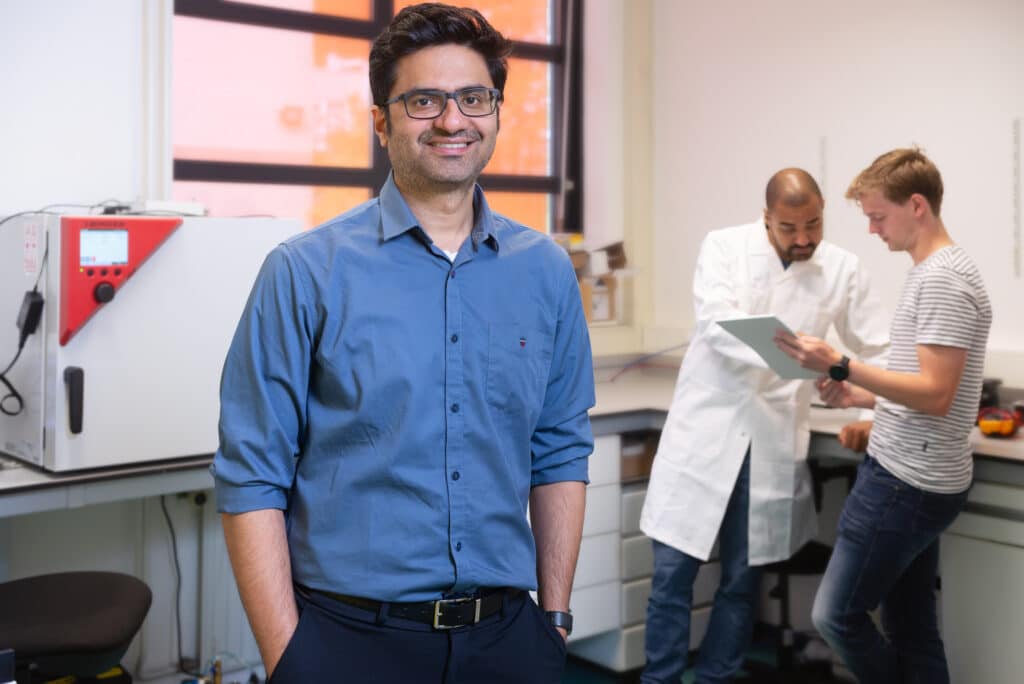
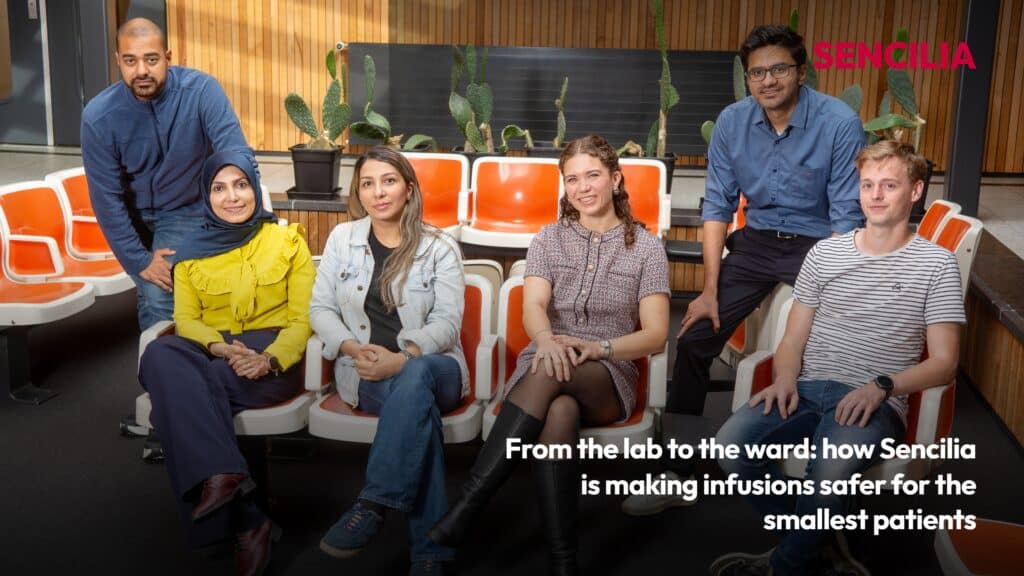
Some researchers publish their discovery and move on to the next paper. Amar Kamat wanted his work to reach actual patients. About five years ago he founded Sencilia, a medtech and deep-tech company building non-invasive sensors that make infusion therapy safer. The Rely-V® sensors clamp onto an infusion tube and measure how fast medication flows without ever touching the fluid.
The problem is anything but abstract. In a neonatal intensive care unit (NICU), a baby might receive medication at roughly a tenth of a millilitre per hour. At that scale, a small error in flow rate isn’t a rounding issue but a safety issue, and the patient on the receiving end is one of the most vulnerable people in the hospital.
“Ending with a publication felt like a copout,” Kamat says. He wanted to build something that mattered, and he knew the cost. The early years meant long hours and very little salary, the typical arithmetic for an early-stage startup. Today the company is expanding rapidly to keep up with early customers who want to engineer and test with the technology, supported by a US-based commercial lead and several experienced clinical and commercial advisors.
The challenge
For Sencilia, the hardest part wasn’t just the science. It was also the money. Deep-tech startups run into what founders call the Valley of Death: the stretch between Technology Readiness Level (TRL) 4 and 6, where an idea has been proven in the lab but isn’t yet a product an investor can easily back. Early Dutch and EU subsidies helped Sencilia get moving, but private investment came with a condition: hit specific commercial milestones first.
Then came a second reckoning, this time from the people who would actually use the device. Conversations with doctors and nurses made one thing clear: the product Sencilia had first envisioned wouldn’t be adopted unless it met the real, specific demands of clinical work. That feedback reshaped the company, pushing it away from a broad, do-everything ambition towards a focused market where it could prove its value. It also meant abandoning the original sensor design after performance issues, a hard thing to do when that idea is where the whole story began.
Where RUG Ventures came in
Sencilia is blunt about one thing: without RUG Ventures, the company wouldn’t exist. RUG Ventures (together with Triade Groep) wrote the first cheque at incorporation: the money that turns an idea into a legal company with a chance to try.
But the value went beyond capital. RUG Ventures helped with financial modelling and pitching, connected the team to partners across the Groningen ecosystem, and gave hands-on support with business development strategy.
Just as important is the structural role RUG Ventures plays. They write smaller, feasibility-sized cheques at the riskiest, earliest moment: the point where a company needs to run a killer experiment to prove the science before it’s ready for a larger vehicle like Future Tech Ventures. “That’s exactly the gap where most promising science quietly dies,” and it’s the gap RUG Ventures is built to fill.
Where things stand
Sencilia isn’t claiming victory and that honesty is part of what makes the progress real. The company started at TRL 2–3, little more than a proven concept. Today it sits at TRL 5, moving from lab prototype toward a scalable product. The next big test is a clinical study at Erasmus Medical Center in Rotterdam, expected Q1 2027, a validation milestone that should move the technology from TRL 5 to TRL 6.
Sencilia is working with several established infusion companies, one of which is currently testing the Rely-V® sensor on its own equipment as part of a paid pilot project. In preclinical bench testing in a simulated NICU setting, Rely-V® detected a blocked IV line in under a minute, where the infusion pump took an hour or more, on ‘time-critical’ drugs whose effect wears off in minutes.
The Groningen ecosystem has been quietly essential. The University of Groningen and Hanze University give Sencilia a strong hiring pipeline, the collaboration with UMCG was instrumental for validation, and the region’s lab infrastructure lets a small team punch above its weight.
Sencilia’s first product is a warning tool: it helps clinicians monitor drug flow and intervene before an interruption harms the patient. The company is aiming for market entry by 2028, with 2027 dedicated to the development that gets them there.
Kamat's advice
“Talk to your end-users and customers early, and understand the job to be done. Don’t get too attached to the technology itself. Building cool tech matters far less than making a product that actually solves a real need.“
For the smallest patients in the hospital, that’s the difference that counts.
NOTE: Rely-V is in development and is not yet CE marked or approved for clinical sale.
Find out more about Sencilia on their website.
Find out more about Amar Kamat on their LinkedIn.